AI Chatbot Development for Customer Support That Hands Off to a Person
Your support team answers the same questions every day, while harder cases wait in the queue. An AI assistant can take the routine ones, so your team has time for cases that need judgment. We build AI chatbots on OpenAI, Anthropic or Google Gemini models. They answer from your help center, documents and order data, and hand off to a person when needed. Infoloop is an AI chatbot development company for customer support, websites and apps.
- <2 minfirst response time with an AI support assistant, down from hours
- 72%less manual support workload for a fintech scale-up
- 5 weeksto first version live
AI chatbots that answer from your records and hand off to a person
Supported after launchHow it is built
- Your own help center
- Cited answers
- Human handoff
Your code, your data, your accounts.
Routine questions, answered. The rest, handed to a person.
AI chatbot development for your industry
Customers and staff ask different questions in every industry. These are the chatbots we would build first in each sector.
Manufacturing
Your sales team takes fewer status calls: distributors check order and dispatch status in chat, straight from your ERP
Automotive and garages
Less time on the phone at the front desk: customers book a service and check job status in chat
AI startups
Answers your users can check: a chat feature in your product, with sources, tested on real questions before release
SaaS and technology
Users solve how-to questions without a ticket: an in-app assistant answers from your help center and release notes
Energy and utilities
Shorter call queues: customers get answers on bills, connections and planned outages in a chat on your site
Consumer platforms
Members are not left waiting: an assistant answers account questions and sends refunds to your team for approval
eCommerce and D2C
Fewer where-is-my-order emails: shoppers track orders and check return rules in a chat connected to your store
Education and training
Learners get help outside class hours: an assistant answers from your course material and hands harder questions to staff
How we work
How we build AI chatbots
Four stages, from the questions you get today to a chatbot in daily use.
 01
Discovery and ticket review
We read a sample of your real tickets and chats to find the questions that repeat. We also note what a wrong answer would cost. If a better help article would fix it, we say so.
 02
Scope and handoff rules
You receive the scope: the questions it answers, the sources it reads and when a person takes over. The cost and the billing model come with it.
 03
Build, connect and test
We connect the chatbot to your help center, documents and order data through their APIs. Each version is tested on real questions with known answers. Your support team tries it on live cases before launch.
 04
Launch and monthly tuning
The chatbot launches with handoff, logging and a tested off switch from day one. Optional monthly support covers monitoring, fixes and a monthly report. Each month we also review what it could not answer and add the suitable questions.
Why teams choose us for AI chatbot development
- 01Answers from your own content, with sources
- 02Hands off to a person and says why
- 03Tested on your real questions before launch
- 04Human approval on refunds and account changes
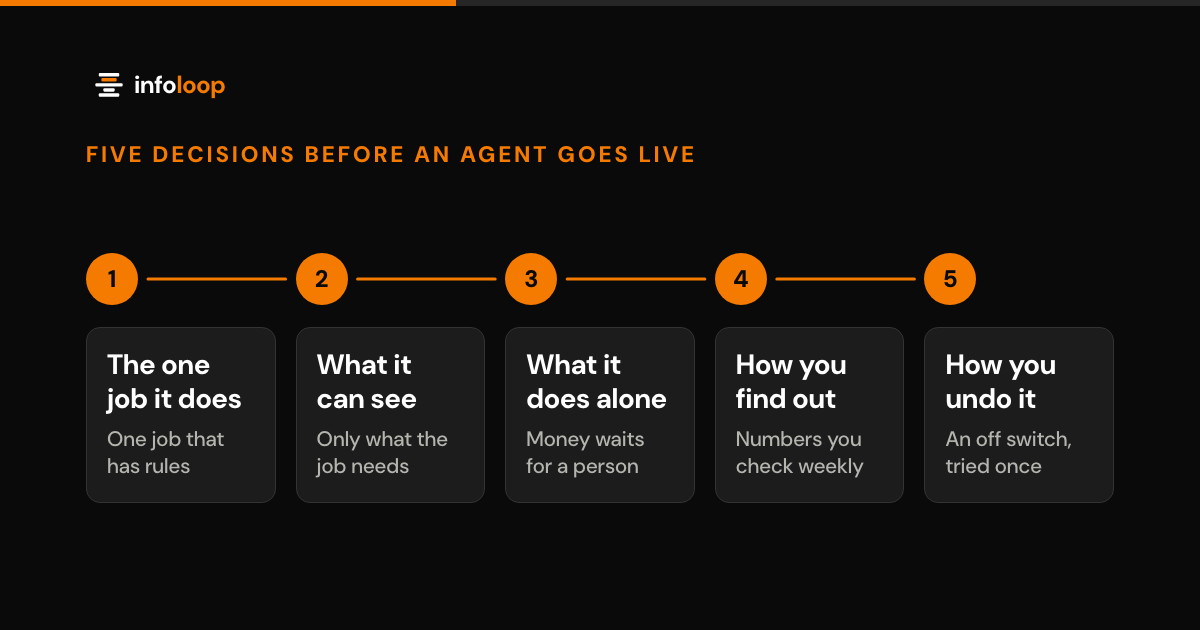
- 05An off switch your team has tested
- 06Our own assistant, Ivy, runs on infoloop.co
- 07Every conversation logged
Answers from your own content, with sources
Why teams choose us for AI chatbot development
Hands off to a person and says why
Tested on your real questions before launch
Human approval on refunds and account changes
Technologies we use for AI chatbot development
| AI models |
|
|---|---|
| Agent frameworks |
|
| Backend |
|
| Frontend |
|
| Mobile |
|
What our clients say
They shipped our support agent in five weeks and it has run ever since. Response time dropped from hours to two minutes.
FAQs
Questions about AI chatbot development
Straight answers. If yours is not here, ask us on the call.
How much does it cost to build an AI chatbot?
At Infoloop, AI chatbot work is scoped as custom software, which starts from $15k. The price then depends on the kinds of questions it answers and the tools it connects to. Content preparation, handoff rules and testing also add to it. A narrow chatbot with up-to-date help content sits nearer that starting point. Model usage is a separate monthly cost you pay the model provider.
How long does it take to build an AI chatbot?
A narrow first version can go live in weeks. The AI support assistant we built for a fintech scale-up went live in five weeks. Time depends on how many kinds of questions it covers and how many tools it connects to. Help content that is out of date adds time. Start with the most common questions, then widen the scope.
AI chatbot vs AI agent: what is the difference?
An AI chatbot answers questions, while an AI agent also changes things in your tools. A chatbot connected to your order data can tell a customer where an order is. An AI customer service agent can change the address or prepare a refund for a person to approve. We build both, and starting with answers keeps the first version small.
How do you stop a chatbot from making things up?
It answers only from your approved sources and shows where each answer came from. When those sources do not cover a question, it says so. When its confidence is low, it hands the chat to a person instead of guessing. Each version is tested on real questions with known answers before launch, and every answer is logged.
Which help desks and tools can it connect to?
Usually the ones you already use, through the APIs those products provide. That includes your help desk and help center, your store or order records, your CRM and in-house tools. Each connection gets only the access the chatbot needs. Where a product has no API, we explain the reliability cost of any workaround.
When does a person take over?
A person takes over when the customer asks or when the chatbot is not sure of the answer. Anything that moves money or changes an account waits for a person to approve. Each handoff states the reason, so your team does not start from scratch. We set the threshold to favor a handoff over a guess.
Where does our data go?
Only where you approve it. The scope sets what the chatbot may read and what data leaves your business. It also sets where data is processed and how long it is kept. Every conversation is logged, and every project is covered by an NDA. You own the code, the data and the accounts.
Can it work on our website and inside our app?
Yes, one assistant can run on your website and inside your web or mobile app. Both share the same sources and handoff rules. Ivy, the assistant on infoloop.co, is our own example. It answers only from facts we have published and says plainly it is an AI. Visitors who want a person can book a call in the chat.
Bring us your busiest support queue
Bring the support inbox that fills up every weekend, or the chatbot your customers have learned to skip. Or the order-status question your team answers all day. We will tell you whether a chatbot fits and what it costs.