Agentic Workflow Automation for Multi-Step Work, with Approval Built In
Some work passes through several tools and several people before anything gets done. We build AI agents and AI workflow automation that carry it from request to result, across the tools your teams already use. Agents read the input, decide the next step and act within defined permissions. A person approves every high-risk action, and every step is logged. Infoloop is an agentic workflow automation company for multi-step business processes.
- 11 wksto bring nine garages onto one platform, with AI booking and reorder agents
- 0garage branches closed while all nine moved onto the platform
- 72%fewer manual ticket hours within a quarter for a fintech scale-up
Every step logged, every risky action approved
Human approvalHow an agent workflow runs
- Read the request
- Decide the next step
- Act within limits
A person approves anything high-risk.
Many steps, one workflow. A person on every risky call.
Agentic workflow automation for your industry
Each industry runs different multi-step processes across different tools. These are the workflows we automate with agents most often in each sector.
Manufacturing
Maintenance alerts turned into work orders, purchase requests routed for approval, and shift reports compiled from plant data
Automotive and garages
Bookings confirmed and scheduled into bays, parts reorders drafted from stock levels, and reminders sent for every branch
AI startups
Agent workflows inside your product, with tool permissions, audit logs and human review on risky steps
SaaS and technology
Support tickets triaged, routed and drafted, account changes prepared for approval, and handoffs between teams logged
Energy and utilities
Site inspection findings turned into tasks, compliance evidence gathered from records, and reports prepared for review
Consumer platforms
Refund and account requests checked against policy, then queued for a person to approve before anything changes
eCommerce and D2C
Orders, returns and stock updates handled across your store, inbox and accounting tools, with exceptions sent to staff
Education and training
Enrollment requests processed, course records updated, and learner follow-ups drafted for staff to review
How we work
How we automate workflows with agents
Four stages, from the workflow map to launch and optimization.
 01
Discovery and workflow map
We map each step of the workflow. We note the tools it touches, who decides what, and what an error costs. If a fixed rule or a simple integration would do the job, we recommend that instead.
 02
Solution design and scope
You receive the agent design: the steps it handles and the tools it may read and change. It also shows the approval points, the cost and the billing model.
 03
Build, integration and testing
We build the agent and connect it to your tools through their APIs. Each step gets only the minimum access it needs. Your process owners test it on real cases, and every version is checked against those examples before launch.
 04
Launch and optimization
The workflow launches with approvals and logging active from day one. After launch, optional monthly support covers monitoring and fixes within an agreed service level.
Why teams choose us for agentic workflow automation
- 01Built on LangGraph or the OpenAI Agents SDK
- 02Approval steps on every high-risk action
- 03A full log of each step the agent takes
- 04Minimum access for each tool it uses
- 05Honest advice when a simple rule will do
- 06Unclear cases handed to a person
- 07You own the code, data and accounts
Built on LangGraph or the OpenAI Agents SDK
Why teams choose us for agentic workflow automation
Approval steps on every high-risk action
A full log of each step the agent takes
Minimum access for each tool it uses
Technologies we use for agentic workflow automation
| AI models |
|
|---|---|
| Agent frameworks |
|
| Backend |
|
| Frontend |
|
| Mobile |
|
What our clients say
More cars through the same bays, with fewer staff hours on admin. That is growth that did not cost us a new building.
FAQs
Questions about agentic workflow automation
Straight answers. If yours is not here, ask us on the call.
What is agentic workflow automation?
It is software where AI agents carry a multi-step process from request to result. An agent reads the input, decides the next step and acts in your tools, such as updating a record or drafting a reply. Unlike a fixed script, it can handle variation. A person approves any step that is high risk.
Which tools can an agent workflow integrate with?
Usually the ones you already use: your CRM, ERP, inbox, accounting software, spreadsheets and in-house tools, through the APIs those products provide. Each step gets only the access it needs. Where a product has no API, we explain the reliability cost of any workaround.
How do you keep agents from taking the wrong action?
Each agent works within defined permissions and can only use the tools listed in the agreed scope. Any step that spends money, changes a critical record or contacts a customer waits for human approval. When confidence is low, the agent passes the case to a person. Every step is logged and can be switched off.
How long does an agentic workflow take to launch?
It depends on the number of steps and tools involved. As a reference, our fintech support assistant went live in five weeks. Brightlane Auto Group moved nine garages onto one platform with AI booking and reorder agents in 11 weeks.
Who owns the agent and the data it uses?
You do. The code, the data and the accounts it runs in belong to your business, and every project is covered by an NDA. At handover, your team receives the documentation and logins, so it can run the workflow without us.
What support is there after launch?
Optional monthly support covers monitoring, fixes within an agreed service level and a monthly report. The report shows what the agent handled, what it passed to a person and what it got wrong. Support is priced separately from development.
How is agentic automation different from RPA or Zapier-style automation?
Rule-based automation follows fixed steps and stops when the input does not match. An agentic workflow reads unstructured input such as emails, documents or chat messages, decides the next step within limits you set, and hands anything unclear to a person. Many workflows combine both: fixed rules where the path is predictable, an agent where judgment is needed.
What does agentic workflow automation cost?
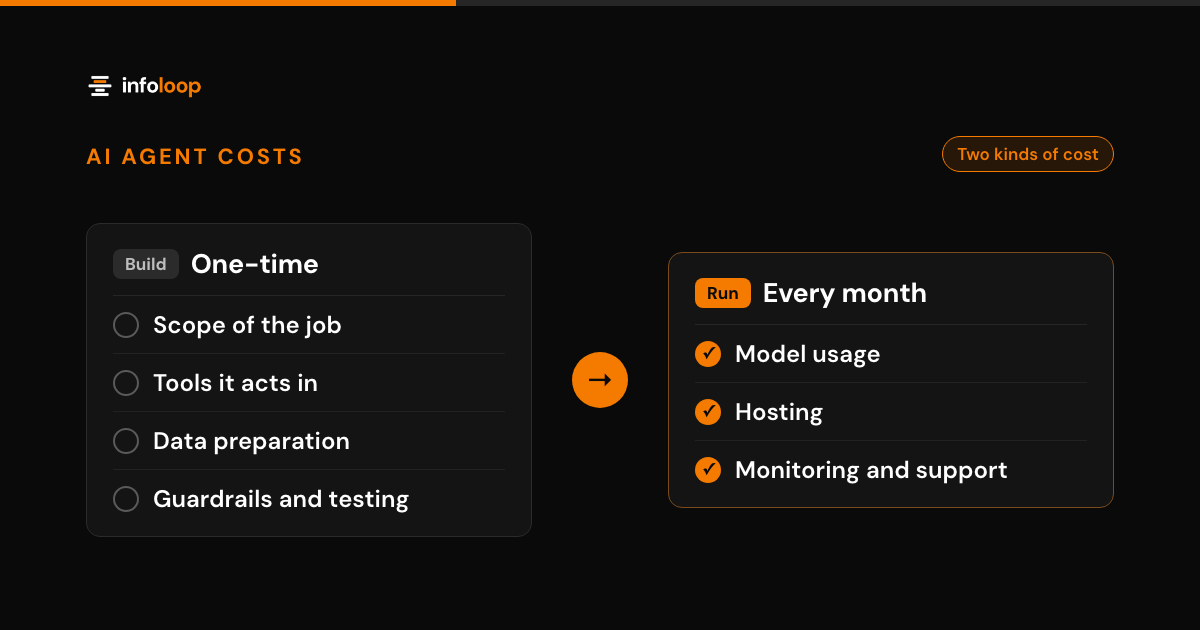
Agentic workflows are scoped as custom software, which starts from $15k at Infoloop. The cost follows the workflow: how many steps and tools it spans, how much data needs preparing and how many actions need approval. Model usage is billed by the provider each month. Starting with one workflow keeps the first build small.
Which workflows should we automate with agents first?
Start with work that happens often, follows known rules and already has a person checking it. Good first candidates are intake and triage, order and invoice handling, and reports compiled by hand. Each should have a clear cost of errors and a result you can measure. If a simple rule or form would do the job, we say so.
Bring us a workflow that eats your week
Bring the request that passes through four inboxes or the order someone retypes into three tools. Or the approval chain that stalls every Friday. We will tell you which steps an agent can take on and what it costs.