AI agents, vertical products and new pricing models are changing how B2B software is made and sold.
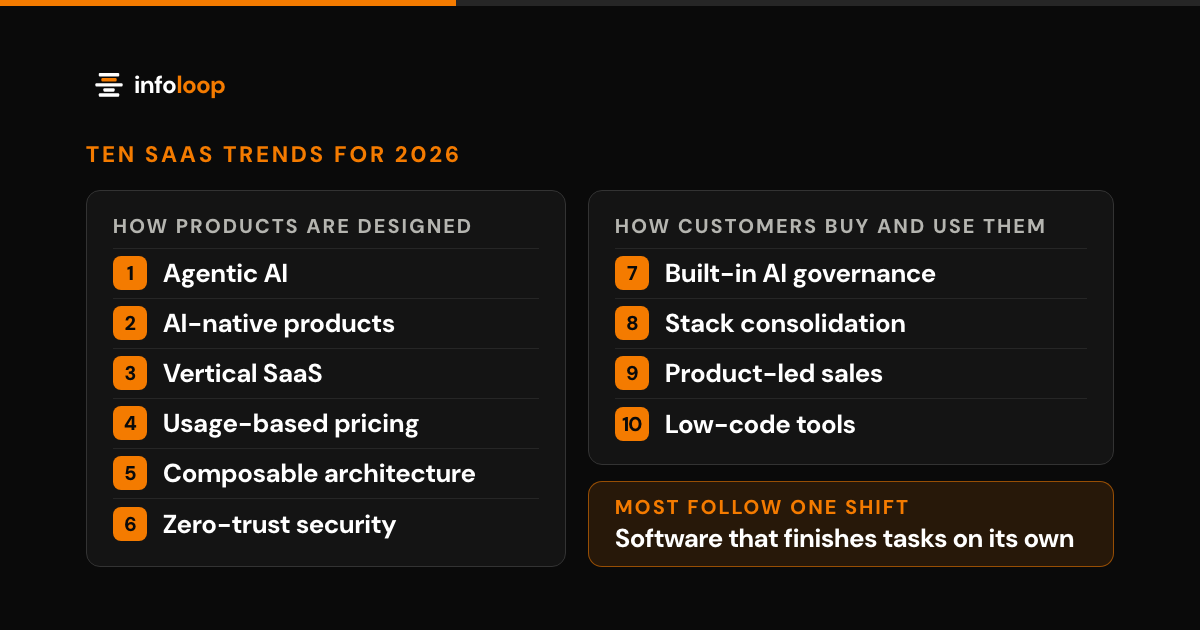
The top SaaS trends for 2026 are agentic AI, AI-native products, vertical SaaS and usage-based pricing. Composable architecture, zero-trust security, built-in AI governance, stack consolidation, product-led sales and low-code tools round out the ten. Most follow one shift: software that finishes tasks on its own. Pick the two or three that fit your product.
Key takeaways
- The biggest shift is from software that helps people work to software that finishes tasks on its own.
- Vertical SaaS and usage-based pricing reward teams that know one industry well and can show value per task.
- Pick the two or three trends that fit your product, test a small version with users, and watch the rest.
SaaS (software as a service) is software that customers rent by subscription and use over the internet. Investment in software is still growing. Gartner’s July 2026 IT spending forecast puts worldwide software spending at about $1.47 trillion this year, an increase of 15.5% over 2025. Gartner expects AI-related software, cloud services and infrastructure to grow fastest. So the real question for most product teams is not whether to add AI, but where it delivers measurable value for customers.
What are the top SaaS trends for 2026?
The top SaaS trends for 2026 are agentic AI, AI-native products, vertical SaaS, usage-based pricing, composable architecture and zero-trust security. Built-in AI governance, stack consolidation, product-led sales and low-code tools complete the list. The first six change how B2B products are designed. The last four change how customers evaluate, buy and use them. The table shows what changes and a practical first step for each.
| # | Trend | What changes | A first step |
|---|---|---|---|
| 1 | Agentic AI | Software completes tasks, not just suggests | Pick one task an agent can own from start to finish |
| 2 | AI-native products | AI shapes the core workflow and data model | Redesign one workflow so AI drafts and people approve |
| 3 | Vertical SaaS and vertical AI | Buyers want tools made for their industry | Choose one industry and learn its rules in depth |
| 4 | Usage-based pricing | Price follows tasks, credits or outcomes | Meter the unit your customers value |
| 5 | Composable architecture | Products become services joined by open APIs | Publish clean APIs and event feeds |
| 6 | Zero-trust security | Every user, device and agent is checked each time | Give each agent its own identity and least access |
| 7 | Built-in AI governance | Buyers ask for proof of how AI is controlled | Log AI actions and keep an audit trail |
| 8 | Stack consolidation | Finance teams cut overlapping tools | Show which tools your product replaces |
| 9 | Product-led sales | Self-serve trials pass warm accounts to sales | Define the usage signals that mean “ready to buy” |
| 10 | Low-code for internal tools | Business teams build simple apps themselves | Offer connectors, templates and webhooks |
What does each trend mean for a B2B SaaS team?
Each trend asks a B2B SaaS team to change one thing: how the product works, how it is priced or how it is sold. Below, each one has a short definition, the reason it matters now and one practical action.
1. Agentic AI: software that finishes the job
Agentic AI is software that plans and completes a task by itself, rather than a tool that only answers questions. For example, an agent can read a support ticket, check the order history, issue a credit within approved limits and close the case. In August 2025, Gartner predicted that up to 40% of enterprise applications would include task-specific agents by the end of 2026, up from less than 5% in 2025. Start with one repetitive task that follows clear rules, and let an agent handle it completely. Keep a person responsible for approving anything that moves money or changes a contract. Before it goes live, settle five decisions about its job, data, limits, alarms and off switch.
2. AI-native products
An AI-native product is designed around AI from the beginning, instead of receiving a chat window as an afterthought. Its data model, workflow and interface all assume that a model performs part of the work, while users review and approve the results. One useful test: if you removed the AI, would the product still make complete sense? If the answer is yes, the AI is probably an add-on rather than the foundation. Redesign one core workflow so the AI prepares the first draft and people check it before anything is final.
3. Vertical SaaS and vertical AI
Vertical SaaS is software designed for one industry, so it arrives with the right fields, workflows and regulations already built in. Among the vertical SaaS trends this year, the most important is vertical AI: models that understand the documents and records of a single industry. A model that knows maintenance logs in manufacturing, or course records in EdTech, can give better answers than a general assistant. Choose one industry, study its processes and regulations in depth, and deliver what a general product cannot. We build our own products this way: OpsDeck for manufacturers and GarageZone for workshops and service centers.
4. Pricing based on usage and outcomes
Usage-based pricing is a model where customers pay for what they use or achieve, such as tasks, credits or outcomes, not for seats. AI is pushing more SaaS companies toward it, because one agent can do the work of several people, so a price per user stops matching value. Gartner’s August 2025 agent forecast also expects a third of user experiences to move to agent interfaces by 2028, bringing new pricing models. The pricing section below explains what this means for your product roadmap.
5. Composable, API-first architecture
Composable architecture means a product is made of separate services that talk through open, documented APIs. Customers can adopt the components they need and connect them to the rest of their technology stack. This matters more in 2026 because AI agents operate through APIs, not through screens, so clean interfaces make a product easier to automate. ChatGPT, Claude, Gemini and Microsoft Copilot can all connect to software through the Model Context Protocol (MCP), an open standard hosted by the Linux Foundation’s Agentic AI Foundation since December 2025. List the ten actions customers perform most often, and expose each one through a documented API and event feed.
6. Zero-trust security
Zero trust means that no person or device receives access simply because it is connected to a company network. NIST SP 800-207, the US government’s 2020 guide to zero trust, describes this model, in which identity and device checks happen before every session. In 2026, the newest users of SaaS products are AI agents, and each one needs its own identity, minimum permissions and an activity log. In February 2026, NIST’s National Cybersecurity Center of Excellence published a concept paper on applying identity and authorization standards to AI agents. Expect enterprise buyers to ask about agent access during security reviews, and document your approach before those questions arrive.
7. Built-in AI governance and compliance
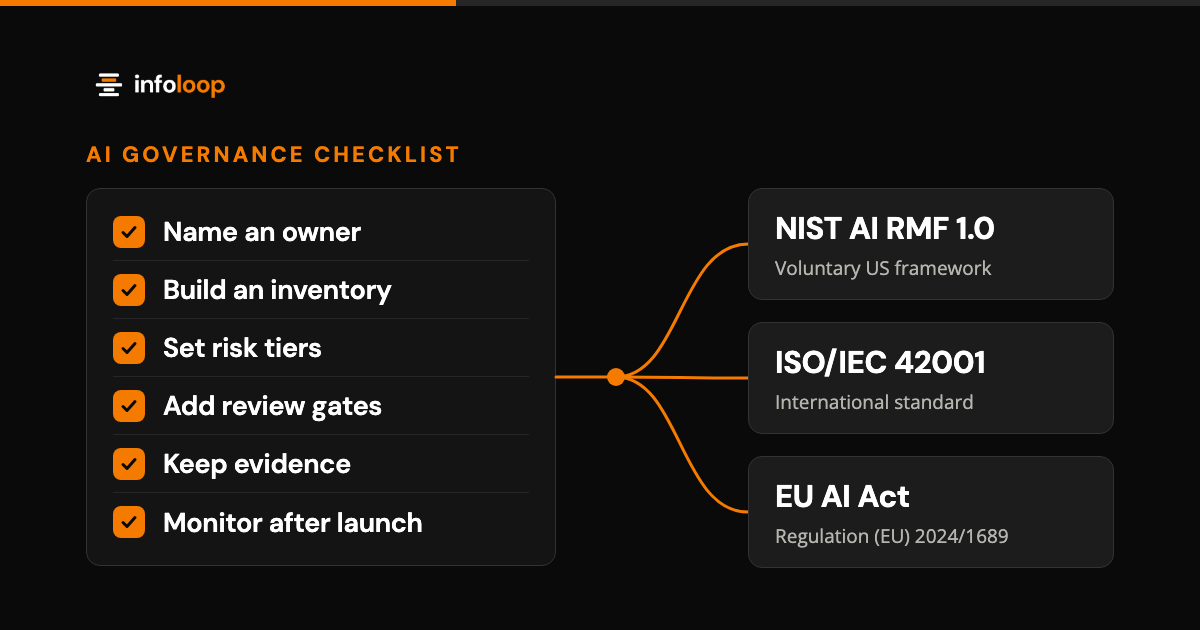
Buyers increasingly want evidence that AI features are tested, controlled and traceable. Regulations such as the EU AI Act and security audits such as SOC 2 both expect documented evidence rather than promises. For high-risk uses, the EU AI Act’s rules now apply from December 2, 2027, or August 2, 2028 for AI built into regulated products, after an amendment known as the AI Omnibus took effect on July 27, 2026. Build activity logging, human review steps and model version records into the product from the beginning, because adding them later is expensive. Our guide to an AI governance framework explains each component in more detail. Our own product, Verko, collects that evidence automatically and maps one set of controls to each framework you report against.
8. Stack consolidation and spend control
Many companies pay for more software than they use, and finance teams are looking harder at overlapping tools. A product that replaces two or three separate tools has an easier renewal conversation. A product that performs one narrow job must integrate cleanly with the tools around it. Identify which tools your product replaces, and state that clearly in your sales material and on your pricing page.
9. Product-led growth with sales assistance
Product-led growth lets buyers try a product before they speak with sales. In B2B, many teams get better results by mixing self-serve trials with timely help from a salesperson. Usage data shows which accounts are ready to buy, and the sales team contacts them at that moment. Define three or four signals, such as team invitations or weekly use of a key feature, and send them straight to your CRM.
10. Low-code for internal tools
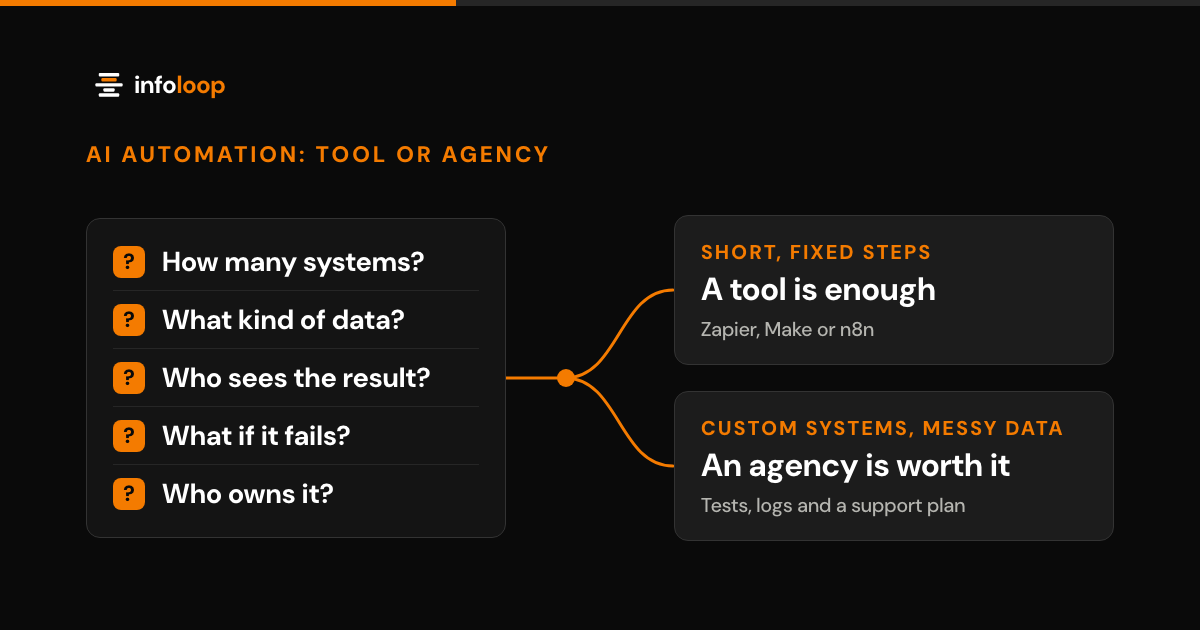
Business teams now create simple applications and automations on low-code platforms without waiting for developers. That changes what they expect from your product: connectors, templates and webhooks they can configure themselves. Provide those building blocks, and keep the core business logic in tested code that your engineers control. Our guide to AI automation tools shows where tools like Zapier, Make and n8n stop working.
Is SaaS being replaced by AI?
No. AI is changing what SaaS products do and how they are priced, but agents still need software to operate inside. An agent depends on clean data, permissions, business rules and an audit trail, and a well-designed SaaS product provides all four. The software most at risk is a thin application that only moves information between screens, because an agent can do that directly. In July 2026, Gartner estimated that up to $234 billion of enterprise application software spending, about 20% of enterprise SaaS spending, is at risk from AI agents by 2030. Its advice to software vendors is to base their value on outcomes rather than on screens.
Expectations are also running ahead of results. In June 2025, Gartner predicted that over 40% of agentic AI projects would be canceled by the end of 2027. It gave three reasons: rising costs, uncertain business value and weak risk controls. The products that benefit will combine AI with the records, rules and permissions that a business already depends on.
What does usage-based pricing mean for a B2B SaaS roadmap?
It means pricing becomes a product feature, not only a finance decision. If customers pay per task, per document or per credit, the product must count those units accurately and display them clearly. Many B2B companies settle on a hybrid model: a base subscription for access, plus usage charges above an agreed level.
Plan these roadmap items before you change your price list:
- Metering. Count each billable unit where it happens, and store every count in one central record.
- Usage dashboards. Show customers what they have used so far this period and what it will cost.
- Spending limits and alerts. Let admins set caps so nobody gets a surprise bill.
- Billing logic. Support base fees, tiers, prepaid credits and additional usage in one billing platform.
- Cost per unit. Know what each task costs you in AI and cloud fees, so every price covers it.
Test the new model with a small group of customers before a general release. Pricing changes are difficult to reverse once contracts are signed.
SaaS trends 2026: which should you act on first?
Act first on the trends that match a problem your customers already describe. Not every emerging SaaS trend deserves a place on this year’s roadmap, so a short filter helps:
- Does this trend solve a problem that customers mention in sales calls or support tickets?
- Can you test it within a few weeks using a small version, rather than a complete rebuild?
- Will it improve a metric you already track, such as activation, retention or average deal size?
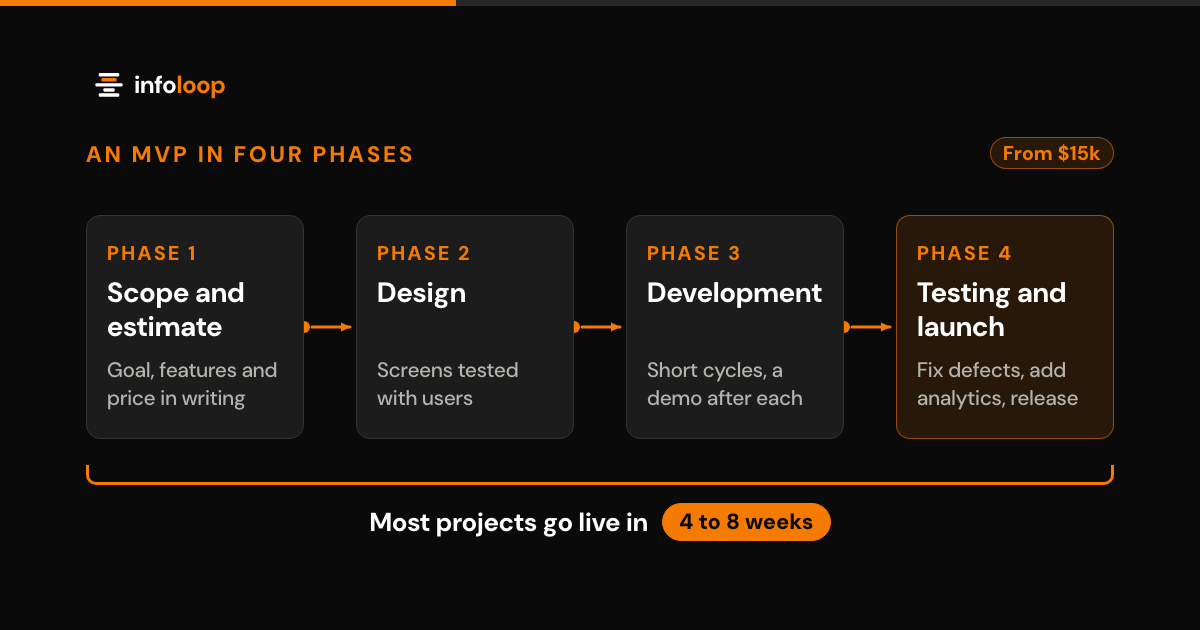
If a trend passes all three questions, build a small version, measure the result and then decide. Our guide to MVP software development explains how to scope that first version. Keep the remaining trends on a watch list, and review that list every quarter.
How Infoloop helps SaaS teams
Infoloop designs, develops and extends software for B2B SaaS companies, AI startups and ISVs. Our SaaS product development team adds AI features, usage metering, integrations and security controls to new or existing products. You receive a written estimate before any work begins. Clear scope is billed at a fixed price, while evolving scope is billed hourly. Custom software, including MVPs, starts from $15k, and most projects go live in 4 to 8 weeks.
Our AI delivery has measurable results. One AI support assistant reduced manual support work by 72% and gave a first response in under two minutes. Its first version went live in five weeks. Verko, our AI governance and compliance product, covers 15+ frameworks from the EU AI Act to SOC 2. Software from Infoloop’s 50+ projects is live in 6 countries, and the company is rated 4.8 on average across Trustpilot, Google, Clutch and GoodFirms. See how this applies to your product on our B2B SaaS industry page.
Infoloop works with clients worldwide from offices in Surat, India, and Dover, Delaware. Book a roadmap discovery call to pick the two or three trends worth building first. The 30-minute call covers your goals, users and constraints, and within about a week you receive a written scope, budget and timeline.
Frequently asked questions
What are the top SaaS trends for 2026?
The top SaaS trends for 2026 are agentic AI, AI-native products, vertical SaaS, usage-based pricing, composable architecture and zero-trust security. Built-in AI governance, stack consolidation, product-led sales and low-code tools complete the list. The first six change how B2B products are designed. The last four change how customers evaluate, buy and use them.
What is agentic AI?
Agentic AI is software that plans and completes a task by itself, rather than a tool that only answers questions. For example, an agent can read a support ticket, check the order history, issue a credit within approved limits and close the case. Keep a person responsible for approving anything that moves money or changes a contract.
How should AI agents be secured under zero trust?
Give each AI agent its own identity, minimum permissions and an activity log. Zero trust means no person, device or agent gets access just because it is connected to a company network. Expect enterprise buyers to ask about agent access during security reviews, and document your approach before those questions arrive.
What is vertical SaaS?
Vertical SaaS is software made for one industry, such as manufacturing, automotive or EdTech. It arrives with that industry's fields, workflows and rules already in place. Buyers need less setup, and the vendor can add AI that understands the industry's own documents and records.

Co-founder and CEO
Nimit leads Infoloop's custom software and AI work, for companies whose processes don't fit packaged software.