An MVP is the first working version of your product that real customers can use. Here is how to decide what goes into it, what it costs, how long it takes and which technology to choose.
MVP software development is building the first working version of a product, with only the features early customers need for one key task. You release it to a small group, study how they use it, then decide what to change. At Infoloop, custom software, including MVPs, starts from $15k, and most projects go live in 4 to 8 weeks.
Key takeaways
- An MVP is working software that real customers use, released to test one idea before you invest more.
- Scope drives both cost and timeline, so limit the first version to the features users need to complete one important task.
- Choose popular, well-supported technology and rent standard components such as sign-in, payments and hosting.
This guide answers the questions founders and product managers ask most often. It explains what an MVP includes, how to build one, what it costs, how long it takes and which technology to choose.
What is MVP development?
MVP development is the work of planning, designing and releasing a minimum viable product. That is the first version of a product that real customers can use for a genuine task. The concept comes from the Lean Startup methodology, whose principles page presents the MVP as the step that starts the learning cycle early.
An MVP is small, but it is not a mockup or a demonstration. It contains working code, a real sign-in and real customer data, and it performs one job well enough for users to judge it. Every other feature waits until you have evidence that this job matters to them.
For startups, MVP development answers two practical questions: will customers use the product, and will they pay for it? For an established software company, an MVP can test a new module, a new market or a new pricing idea, such as usage-based pricing, before a full launch.
The table below shows how an MVP differs from a prototype and from a finished product.
| Prototype | MVP | Full product | |
|---|---|---|---|
| Purpose | Test a design or an idea | Test real use and demand | Serve a proven market |
| Who uses it | Your team and a few testers | Early customers | All customers |
| What it is made of | Clickable screens, little or no code | Working code and real data | Working code and many features |
| What you learn | Is the flow clear? | Do people return and pay? | How to grow and keep customers |
How do you build an MVP?
You can build an MVP in six steps, from a one-line problem statement to a release for a limited group of early users. Each step reduces the cost and risk of the following one.
- Write the problem in one sentence. Name the user and the pain they feel today. For example: “Corporate trainers cannot see who completed a course, because the records sit in three separate tools.”
- Set one measurable goal. Decide what result would prove the idea works, such as half of the first users completing the core task during their first week.
- Reduce the feature list. Sort every idea into three groups: essential now, useful later and unnecessary. Only the essential group belongs in version one. If you want help making that cut, product strategy consulting gives you a scoped first release and a budget in writing before you commit.
- Design the main path. Sketch only the screens a user needs to reach the result. Show those sketches to a few target customers before anyone writes code.
- Develop in one- or two-week cycles. Finish every cycle with a demonstration of working software, so you can see progress early and correct mistakes while they are still inexpensive.
- Release to a small group and measure. Track how many new users complete the core task, return the following week and agree to pay. Interview users regularly, then decide whether to improve, change direction or stop.
After release, concentrate on three signals. Activation is the share of new users who complete the core task. Retention is the share who return in later weeks, and conversion is the share who move to a paid plan. Total sign-ups alone reveal little about whether the product delivers value.
The same process applies whether the MVP is a web app or a mobile app. The main difference is the platform decision, which affects both cost and timeline. If you already sell a B2B product and want to test a new module, our B2B SaaS page explains how we build inside your existing codebase.
What does it cost to develop an MVP?
At Infoloop, custom software, including MVPs, starts from $15k. The final price depends on the number of user roles, platforms and integrations in the first version, and on how stable the requirements are.
Most of the cost is the time of skilled professionals. US software developers earned a median of $135,980 a year in May 2025, according to the Bureau of Labor Statistics. An MVP also needs design, testing and project management, so every feature you remove saves several kinds of work, not only programming hours.
These factors usually have the largest effect on price:
| Cost factor | Lower cost | Higher cost |
|---|---|---|
| User roles | One type of user | Several roles with different permissions |
| Platforms | A web application only | Web, iOS and Android |
| Integrations | None, or one standard service | Payments, CRM, ERP or older in-house software |
| AI features | None, or one hosted model | Several models, your own data and review steps |
| Design | Standard components | A custom visual style |
| Data rules | No sensitive data | Personal data, audit logs and strict access control |
The payment model matters as much as the total. Infoloop provides a written estimate before any work begins. Clear requirements are billed at a fixed price, while evolving requirements are billed hourly. For longer engagements, dedicated developers are available on hourly or monthly terms.
Whichever model you choose, check that the estimate lists exactly what it covers. A complete estimate names design, development, testing, deployment and any fixes after launch, so there are no surprises in the final invoice.
How long does an MVP take?
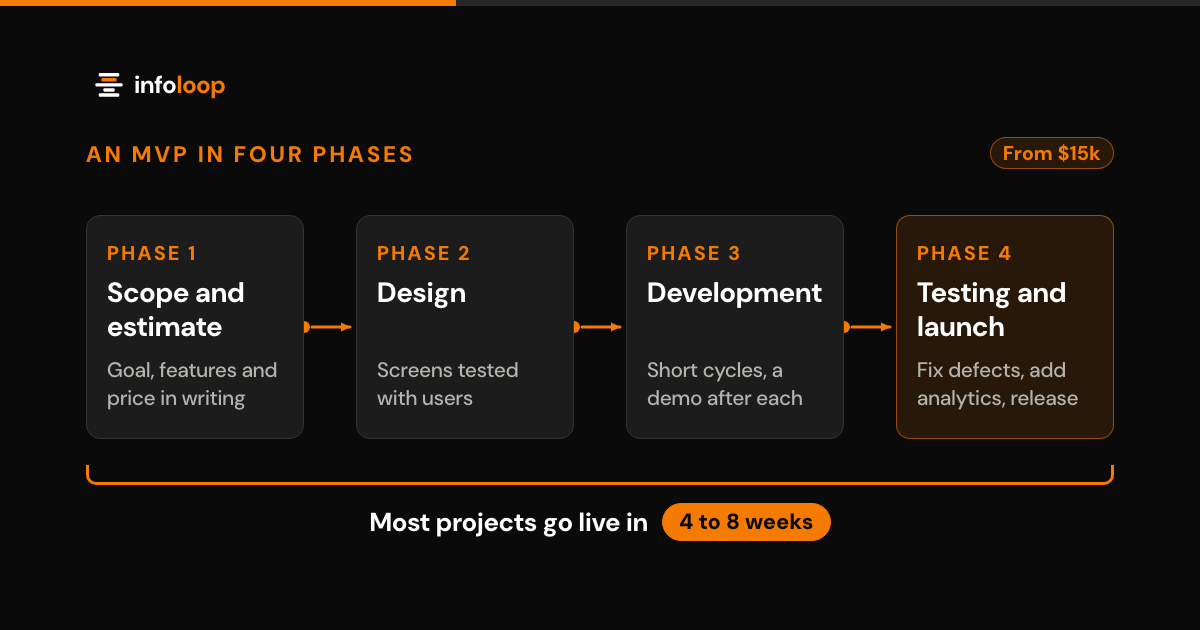
Most Infoloop projects, including MVPs, go live in 4 to 8 weeks. The actual duration depends on the size of the feature list, the number of integrations and how quickly your team makes decisions.
A typical MVP moves through four phases:
- Scope and estimate. Agree on the goal, the feature list and the price in writing before development begins.
- Design. Turn the main path into detailed screens, then test them with representative users.
- Development. Deliver working software in short cycles, with a demonstration at the end of each one.
- Testing and launch. Fix defects, install analytics and release the product to the first group of customers.
The most common delay is adding features during development, followed by slow feedback on demonstrations. External approvals, such as app store review or a payment provider’s verification checks, can also delay a release. So can inconsistent data that must be cleaned before it is imported.
Other habits save time: appoint one person who makes product decisions, and freeze the feature list for the first release. Attend every demonstration, and answer the development team’s questions within one business day.
What tech stack should you use for an MVP?
Choose technology that many developers already know, that suits your product, and that lets you rent standard components instead of building them. A lean stack keeps the first version affordable and makes the code easier to hand over later.
Popular tools are easier to staff, and survey data shows which ones developers use most. In the 2025 Stack Overflow Developer Survey, 66% of respondents used JavaScript, and PostgreSQL was the most used database at 55.6%. Node.js and React were the two most used web technologies, at 48.7% and 44.7%. A common stack means more developers can maintain your code as the product grows.
Use this checklist when you compare options:
- Team experience. Choose languages your developers use every day, because productivity comes from familiarity, not from novelty.
- Rented components. Use managed services for authentication, payments, email and hosting, so developers concentrate on your core feature.
- One codebase where possible. Start with a web application unless mobile is essential. If it is, a cross-platform framework can cover iOS and Android from a single codebase.
- A proven database. A relational database such as PostgreSQL suits most B2B products and handles growing data volumes reliably.
- Security basics from the start. Review the application against the OWASP Top 10, a widely used list of the most critical web application security risks, last updated in 2025.
- AI through an API first. Connect to a hosted model before training your own, and build a custom model only when usage proves the need.
- A planned exit from no-code. No-code platforms can validate demand quickly and inexpensively. Plan the move to custom code before you need complex business rules or heavy traffic.
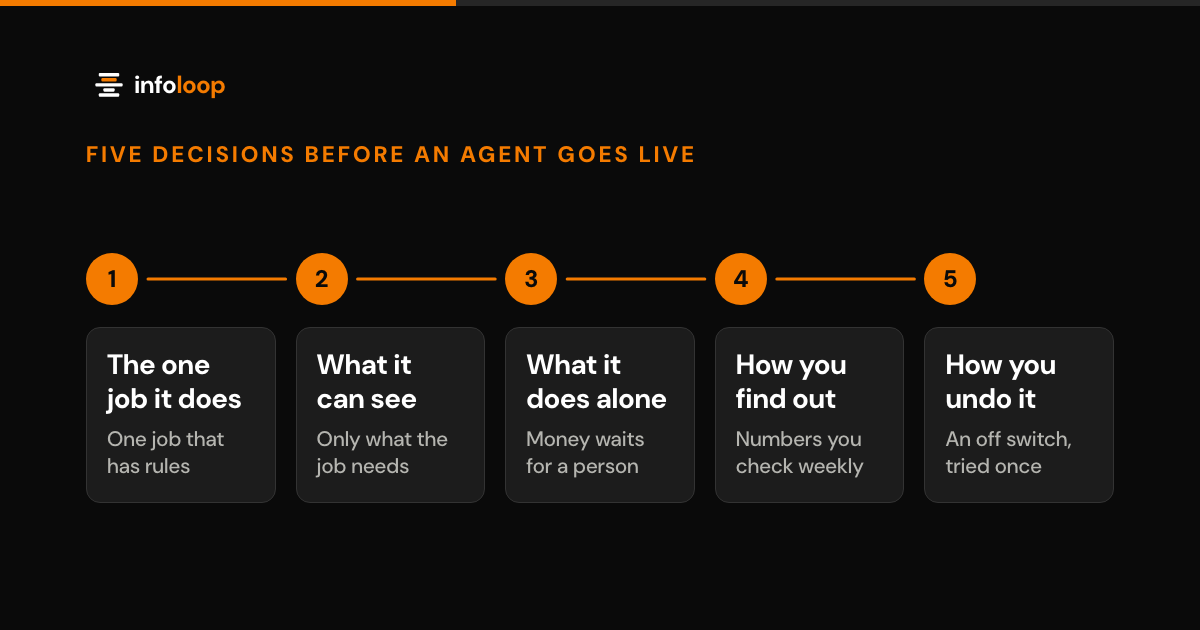
AI startups face additional decisions about model costs, data handling and human review. Our AI startups page explains how we approach them. Before an AI feature goes live, read how to ship an AI agent that survives production.
How Infoloop helps with MVP software development
Infoloop provides MVP development services for startups, SaaS companies and independent software vendors. The team defines the first version with you, then designs, develops and launches it. You receive a written estimate before work begins. Clear scope is billed at a fixed price, and evolving scope is billed hourly. Most projects go live in 4 to 8 weeks.
One example is an AI support assistant whose first version went live in five weeks. It reduced manual support work by 72% and brought first response times under two minutes. Software from Infoloop’s 50+ projects is live in 6 countries, and the company is rated 4.8 on average across Trustpilot, Google, Clutch and GoodFirms.
Infoloop works with clients worldwide from offices in Surat, India, and Dover, Delaware. Book an MVP scoping call and bring your feature list to the 30-minute discovery call. Within about a week, you receive a written scope, budget and timeline for the first version.
Frequently asked questions
What features should an MVP include?
An MVP should include only the features users need to complete one important task. Sort every idea into three groups: essential now, useful later and unnecessary. Build only the essential group. It still needs a real sign-in, real data and basic security, so early customers can use it for genuine tasks.
What does it cost to develop an MVP?
At Infoloop, custom software, including MVPs, starts from $15k. The final price depends on user roles, platforms, integrations, AI features and how stable the requirements are. You receive a written estimate first. Clear scope is billed at a fixed price, and evolving scope is billed hourly.
Can I build an MVP with no-code tools?
Yes, no-code platforms can test demand quickly and at low cost. They suit a first test of whether customers want the product at all. Plan the move to custom code before you need complex business rules or heavy traffic. Rent standard parts such as sign-in, payments and hosting to keep that custom version lean.
Is an MVP the same as a prototype?
No, a prototype is a clickable model for testing a design, while an MVP is working software. A prototype often has no real code behind it. An MVP has a real sign-in and real data, so early customers can use it for genuine tasks and show whether they will return and pay.

Co-founder and CEO
Nimit leads Infoloop's custom software and AI work, for companies whose processes don't fit packaged software.