Here is how manufacturers use ERP, the modules a discrete maker needs, India's GST and job work rules, cost drivers and rollout.
Indian factories should judge manufacturing ERP software on three tests: process fit, GST compliance and a sound Tally link. The right system keeps orders, stock, production, quality and dispatch in one record. Those tests, and the vendor’s support after go-live, matter more than the longest feature list.
Key takeaways
- Choose manufacturing ERP on process fit, number of factories and Indian compliance, then test it with one of your own orders.
- In India, the ERP must generate GST e-invoices, track job work challans and deadlines, and post entries to Tally.
- Cost depends on factories, users, data quality and integrations, so get the scope and price in writing first.
Manufacturing ERP (enterprise resource planning) is software that keeps a factory’s orders, stock, purchasing, production, quality and accounts in one shared database.
Which ERP is best for a manufacturing business?
The best ERP for manufacturing is the one that matches how you make things and how many sites you have. A job shop, a batch process plant and a multi-plant parts supplier need different tools. For Indian factories, GST e-invoices, job work tracking and a clean Tally link are also must-haves. Most options fall into five groups.
| Option | Good fit | Watch for |
|---|---|---|
| Large global suite | Groups with many factories, several countries and an in-house IT team | Long rollouts, partner fees and heavy change for the shop floor |
| Mid-market cloud ERP | Growing firms with one to five factories | Indian features may need add-ons or a local partner |
| India-built product for manufacturers | Factories that want GST, job work, Tally and payroll ready to use | Depth for your production method |
| Custom ERP | Unusual processes, or many existing tools to connect | Needs a clear scope and support after launch |
| Accounting software plus spreadsheets | Very small units | Fails once you track batches, job work or a second site |
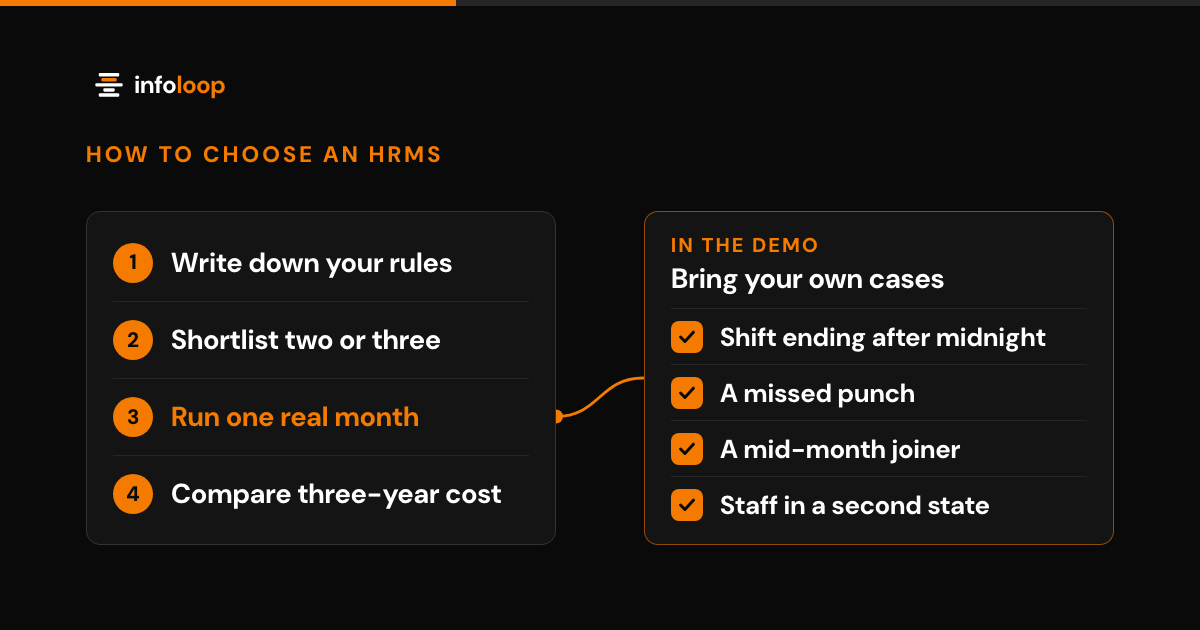
Shortlist two or three candidates. Then ask each vendor to show one of your real orders in a demo, from quotation to dispatch and invoice. Whatever the demo skips tells you more than any brochure.
How is ERP used in manufacturing?
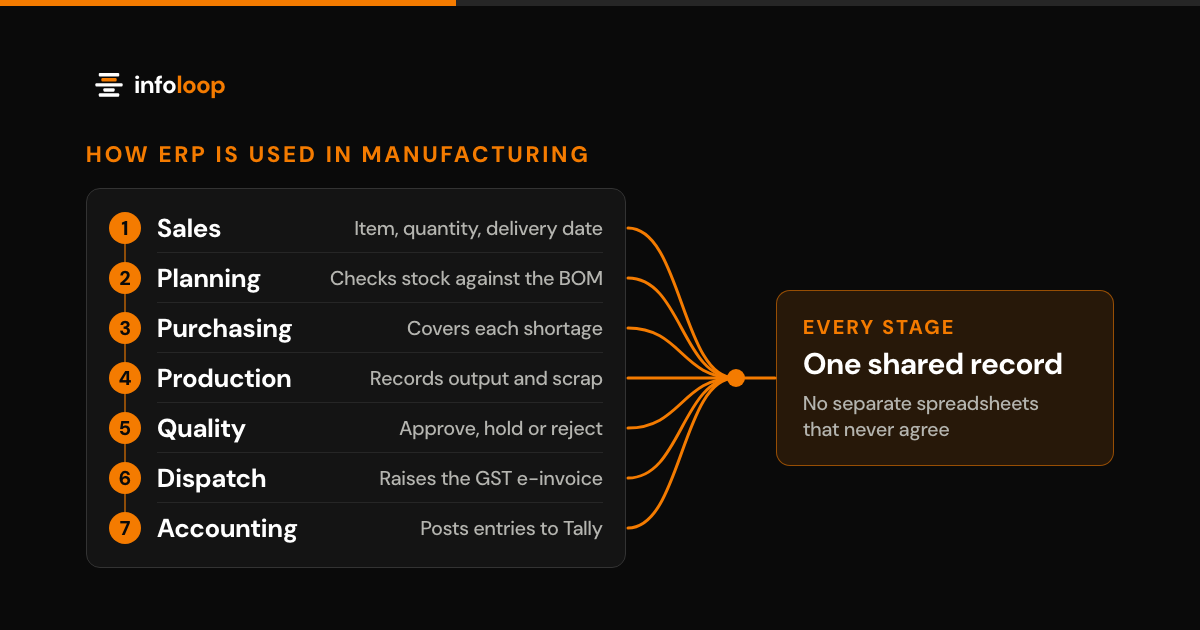
ERP is used to plan, produce and deliver orders from one shared set of data. A sales order becomes a production plan, the plan generates purchase orders, and the shop floor reports progress against it. A typical order follows seven stages.
- Sales. A confirmed customer order sets the item, the quantity and the delivery date.
- Planning. The system checks stock against the bill of materials, the list of parts and materials in each product. It then lists every shortage.
- Purchasing. Purchase orders cover each shortage, and goods receipts update stock.
- Production. Work orders reach the shop floor, where operators record output, scrap and machine time.
- Quality. Inspections approve, hold or reject each batch.
- Dispatch. Each shipment raises the invoice, the e-invoice and the stock entry together.
- Accounting. Sales, purchases and stock values flow into the accounts.
When every stage shares one record, the stores, production and accounts teams stop keeping separate spreadsheets that never agree.
What are the core ERP modules for discrete manufacturing?
Discrete makers need nine core modules: item master and BOM, planning (MRP), purchasing, shop floor, quality, inventory, job work, sales and dispatch, and costing. Discrete manufacturing makes items you can count, such as pumps, castings, electrical panels or auto parts. Process manufacturing makes goods in batches from a formula, such as paint, food or chemicals.
| Module | What it does | What to check in a demo |
|---|---|---|
| Item master and BOM | Holds every part and the multi-level bill of materials (BOM) for each product | Versions and approvals when a design changes |
| Planning (MRP) | Compares demand with inventory and open orders, then lists shortages | Planning by factory and by delivery date |
| Purchasing | Raises purchase orders and tracks supplier deliveries | Matching of order, goods receipt and supplier bill |
| Shop floor | Issues work orders and records output, scrap and labor time | Barcode or tablet entry at each work center |
| Quality | Records inspections and sends failed lots to hold, rework or scrap | A path from each defect back to the lot and supplier |
| Inventory | Tracks inventory by warehouse, bin and lot | FIFO picking and live inventory value |
| Job work | Tracks material sent to subcontractors and what comes back | Challans and inventory held at each job worker |
| Sales and dispatch | Turns orders into delivery notes and GST invoices | E-invoice and e-way bill from one screen |
| Costing | Adds up material, labor and overhead per job | Planned against actual cost for each order |
Add an HR and payroll module if labor hours should feed job costing. Add a CRM if your sales team wants quotations and customer follow-ups inside the same system.
What should ERP software for the manufacturing industry cover in India?
In India, manufacturing ERP must cover four areas: GST e-invoices, job work challans, ITC-04 data and a Tally link. It should treat GST as part of daily work, not as a month-end export.
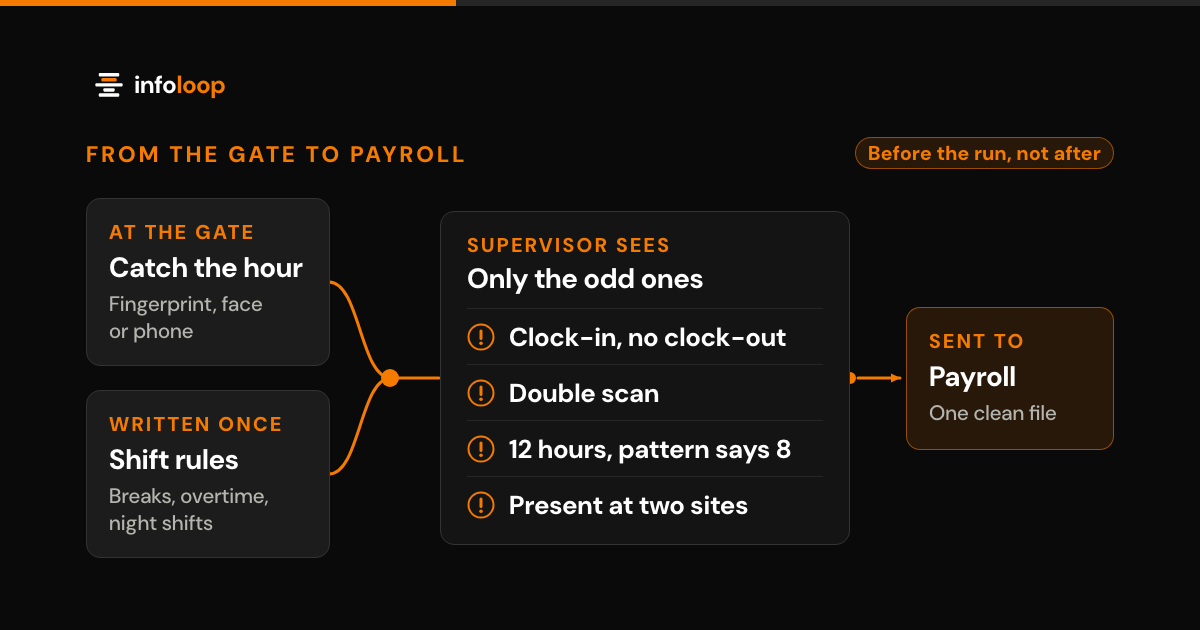
GST e-invoices. E-invoicing has been mandatory since 1 August 2023 for B2B invoices and exports by any business whose aggregate turnover exceeded ₹5 crore in any financial year since 2017-18, under Notification 10/2023-Central Tax. Since 1 April 2025, a business with aggregate turnover of ₹10 crore or more must also report each invoice to the invoice registration portal within 30 days of its date, or the portal rejects it (GST e-invoice advisory). So the ERP should report each invoice as it is raised. Nobody should have to retype invoices into a government portal.
Job work. Many factories send components out for plating, heat treatment or machining. Under GST, inputs sent to a job worker must return within one year, and capital goods within three years. The GST Council’s job work flyer explains this, and notes that molds, dies, jigs, fixtures and tools are exempt from the return requirement. So the ERP should issue each challan, show stock at every job worker and warn you before a deadline passes.
ITC-04 data. The same job work records feed Form GST ITC-04. According to the GST portal’s user guide, since 1 October 2021 businesses with aggregate turnover above ₹5 crore in the preceding financial year file it half-yearly, and smaller businesses file it annually. An ERP that tracks challans well turns this return into a short task.
Tally. If your accounts team keeps the books in Tally, the ERP should post sales, purchase and stock entries there. That avoids double entry and lets your accountant keep a tool they trust. Ask how often it syncs and who fixes a failed entry. If you still run Tally.ERP 9, plan the link against TallyPrime: Tally stopped renewing Tally.ERP 9 support subscriptions on 16 August 2026.
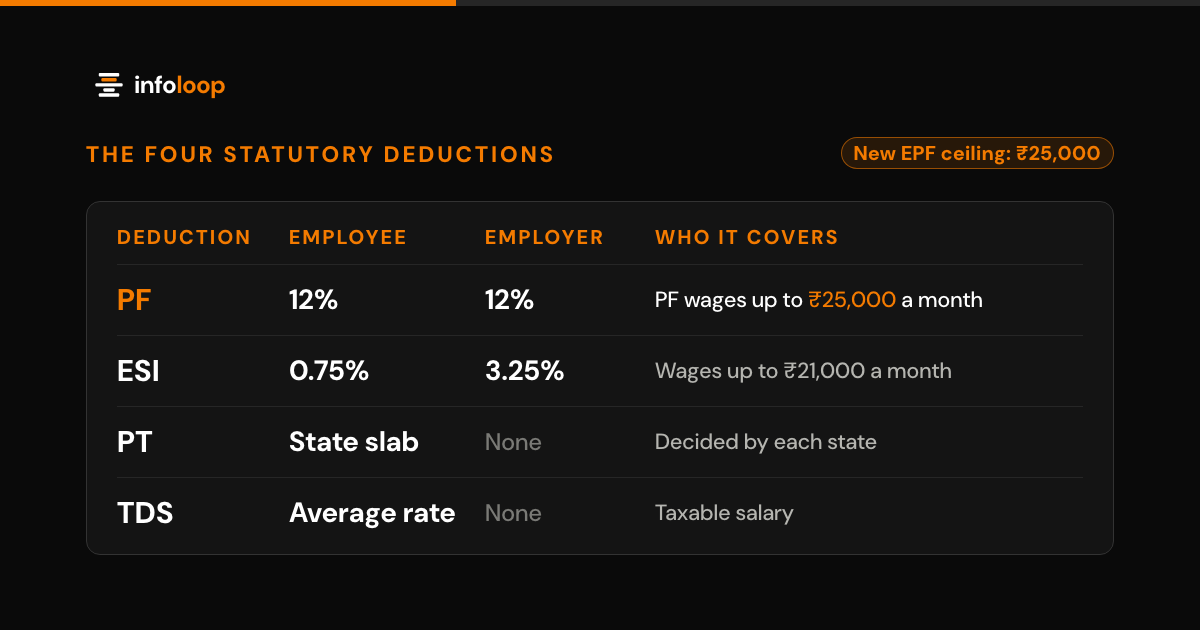
If the ERP includes HR, payroll should also calculate PF, ESI, professional tax and TDS, where they apply, from the same attendance records. It should also apply the single definition of wages that the Labour Codes brought in on 21 November 2025. According to the Ministry of Labour and Employment’s FAQs on Labour Codes, the part of allowances above 50% of total pay counts as wages.
OpsDeck’s ERP module covers the e-invoice and job work steps above in daily work. Each dispatch raises the GST e-invoice, and material sent out for job work gets its challan in the same step, then stays visible as stock at the subcontractor. See how OpsDeck handles GST and job work.
How can cloud ERP help a small factory in India?
Cloud ERP lets a small factory begin without servers or a dedicated IT team. The vendor hosts the software, installs updates and maintains backups.
- Owners check orders, stock and dispatches from the office, the plant or a phone.
- Supervisors record production on the shop floor, so nobody retypes paper slips at night.
- A second factory or warehouse becomes a new location, not a separate system.
- When GST rules change, as the rates did on 22 September 2025, the fix should arrive as a software update.
Start small. A sensible first phase covers stock, purchasing and dispatch with GST invoices. Add planning and shop-floor tracking once your item data is clean. Also ask what happens when the internet drops, and how floor entries catch up later.
What does implementing manufacturing ERP involve?
Implementing manufacturing ERP means mapping your process, cleaning your data, setting up the system, training people and going live in phases. Scope and data quality shape the cost more than the software license does. A typical implementation follows six steps.
- Map how orders, materials and money move today, factory by factory.
- Agree the scope of phase one and the reports each manager needs.
- Clean the item master, BOMs, opening inventory and supplier records.
- Configure the system, the GST settings and the Tally integration.
- Test with real orders, then train each department on its own screens.
- Go live one factory or one module at a time.
Seven factors drive the cost.
- The number of factories, warehouses and GST registrations.
- The number of users and the modules each one needs.
- Your process type, and the complexity of your BOMs and routings.
- The state of your item and stock data before it moves.
- Links to Tally, biometric devices, barcode scanners and customer portals.
- Custom reports, approval steps and print formats.
- Training, and support after go-live.
Ask for the scope, timeline and price in writing before work starts. Every factor is then visible, and nothing appears later as a surprise.
What do automotive component makers need from ERP?
Auto component makers need ERP that proves where every part came from and keeps pace with changing schedules. OEM buyers expect lot tracing, controlled design changes and quality records that pass an audit.
- Quality system. Your customers may require IATF 16949, the quality management standard for the automotive supply chain. The ERP should hold the records an auditor asks for: checks, deviations and corrective actions. The IATF plans a second edition of the standard for mid-2027, with more weight on lower-tier supplier management, launch management and customer-specific requirements (IATF communiqué, July 2026). Choose an ERP whose quality records you can extend.
- Traceability. Each lot, heat number or batch should trace back to its raw material and forward to the customer shipment. That turns a recall into a quick search, not a week of digging.
- Schedules. OEM delivery schedules change often. Planners need to see each change against stock and machine capacity.
- Job work. Plating, heat treatment and painting often go to outside job workers, so challans and deadlines matter here as well.
- Rejections. Track rejections by customer, part and cause, in parts per million if your customer measures quality that way.
- Revisions. Every part revision needs an approval history, so operators never work from an old drawing.
OpsDeck traces every batch back to its raw material lots and forward to every product that used them, and its engineering change orders keep a full approval history. See the OpsDeck ERP module.
How Infoloop helps
OpsDeck is Infoloop’s HRMS, CRM and ERP software for Indian manufacturers. It has three modules on one record: HRMS and Recruitment, CRM, and ERP. The ERP module covers bills of materials, planning, purchasing, job work, shop-floor work orders, quality, inventory and GST e-invoices.
Each dispatch raises a GST e-invoice, with multi-state tax rules for plants in more than one state. HRMS shift data adds labor cost to each batch, so your costing reflects actual hours. At one manufacturer, the OpsDeck attendance module went live across three plants in three weeks. Timesheet admin fell by 90% (read the case study).
Some factories need software shaped around a process no product covers. For them, Infoloop offers custom ERP software development for manufacturers. One custom build was an ERP with predictive maintenance for a machinery maker. It saved $1.2M a year and cut unplanned downtime by 72% (read the case study). You can see more of this work on our manufacturing software page.
Operate a factory in India? Book an OpsDeck demo and watch one of your own orders move from sales order to GST invoice.
Frequently asked questions
How should an Indian manufacturer choose ERP software?
Choose the ERP that fits your production method, your number of factories and India's GST rules. Look for bills of materials, planning, shop-floor tracking, quality and job work, plus GST e-invoicing and a Tally integration. Then test each shortlisted system with one of your actual orders.
How is ERP used in manufacturing?
ERP is used to plan, produce and deliver orders from one shared record. A sales order drives the production plan and the purchase orders. Operators record output and scrap, inspections approve or hold each batch, and dispatch generates the invoice. Accounting then receives every entry without retyping.
What drives the cost of manufacturing ERP?
Scope and data quality drive the cost more than the software itself. The main factors are the number of factories, users and modules, and the complexity of your bills of materials. The condition of your inventory data and the links to Tally and devices also matter. Ask for the scope and price in writing.
Can a small factory in India use cloud ERP?
Yes, and cloud ERP often suits a small factory best. There are no servers to buy or maintain, and managers can review orders and inventory from a phone. Start with inventory, purchasing and GST invoicing, then add planning and shop-floor tracking once your item data is clean.

Co-founder and CEO
Nimit leads Infoloop's custom software and AI work, for companies whose processes don't fit packaged software.