The right payroll tool gets PF, ESI, PT and TDS right every month, from real attendance. Here is how to judge one, what drives the cost, and where AI helps.
The best payroll software in India calculates PF, ESI, TDS and state professional tax accurately from real attendance data, every month. It should apply new regulations quickly, post salary entries to Tally and show how each figure was calculated. Brand and price matter less than a clean test on one of your previous payrolls.
Key takeaways
- The best payroll software in India works out PF, ESI, PT and TDS from real attendance and updates when a rule changes.
- The EPF wage ceiling rose from ₹15,000 to ₹25,000 on 17 September 2026. September contributions are split at that date, and staff with PF wages up to ₹25,000 must now be in EPF, EPS and EDLI.
- Cost depends on headcount, states, attendance devices and links such as Tally, so ask for a demo and a written quote.
That test matters more since September 2026. The EPF wage ceiling increased from ₹15,000 to ₹25,000 on 17 September 2026, under notification S.O. 5109(E). September contributions are split at that date, and from October every covered employee contributes on PF wages of up to ₹25,000.
Which is the best payroll software in India?
The best payroll software in India is the one that passes a test on your own past payroll. No single product suits every company. The right choice depends on how many employees you pay, in how many states, and how they record attendance.
Most options fall into four categories:
- Payroll-only cloud software. It suits offices with fixed salaries and few exceptions.
- HRMS suites with payroll. Leave, attendance, recruitment and salary share one employee record. Our guide to the best HRMS software in India covers this category.
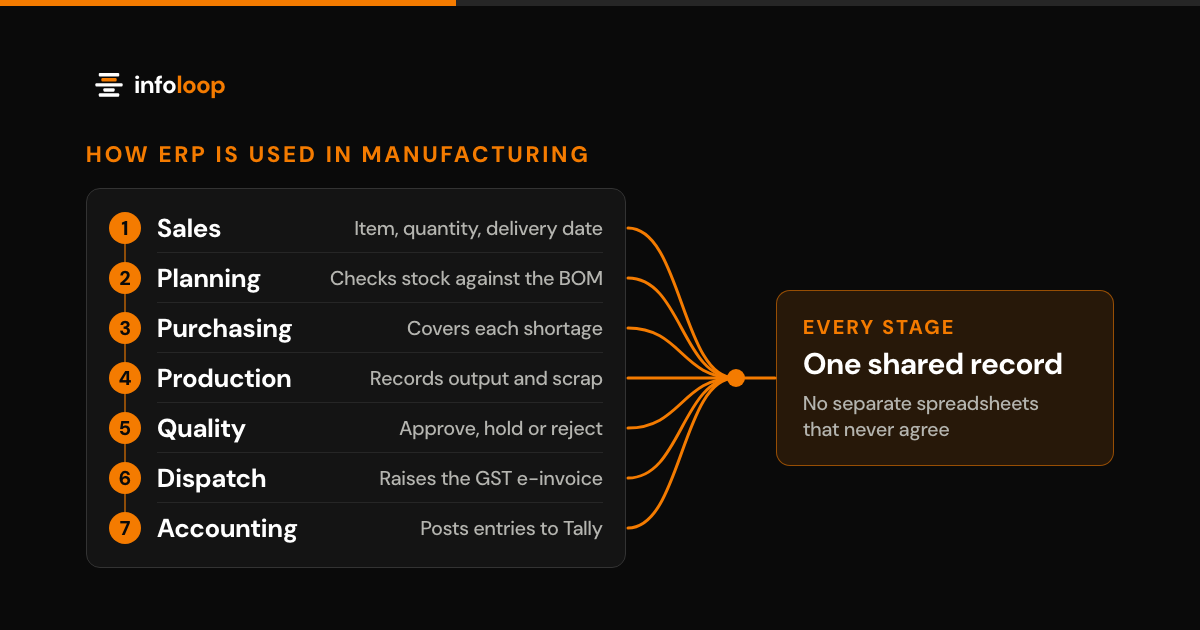
- ERP software with payroll included. Manufacturers choose this when labor hours must also feed product costing, as our guide to manufacturing ERP software in India explains.
- Desktop software managed by an accountant. It works for a very small team, but it depends on one person.
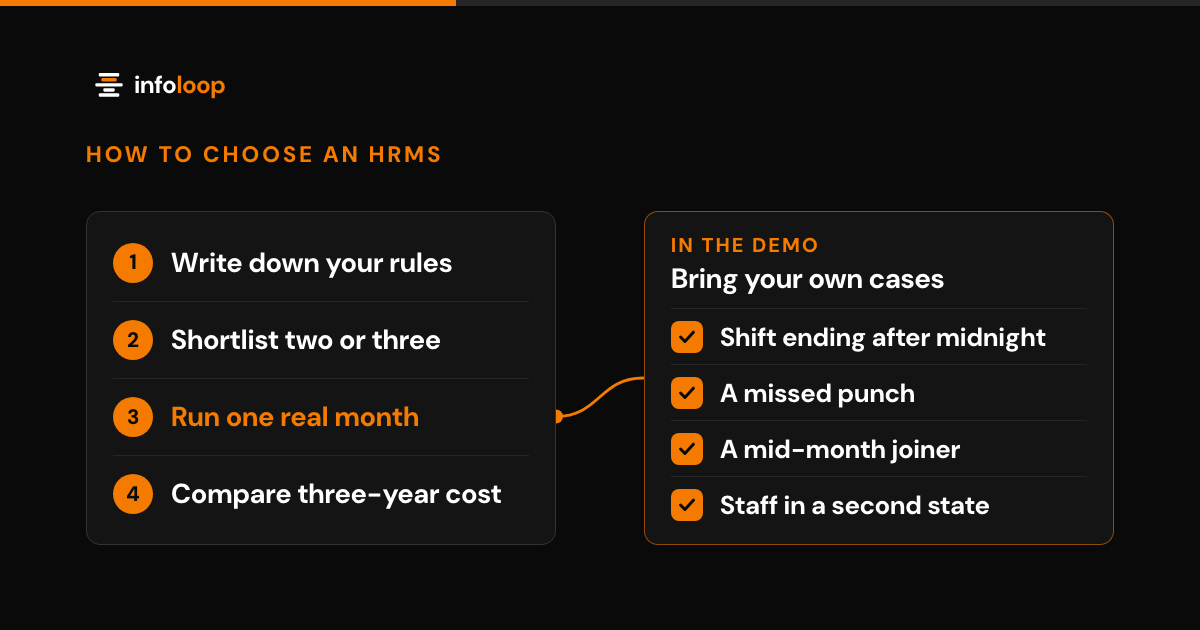
If you are choosing payroll software for a small business, the deciding test is practical. Ask each vendor to process last month’s payroll in their software. Then compare every payslip line with the amount you actually paid.
Is payroll software better than manual payroll?
Yes, payroll software is faster and more reliable than manual payroll once you employ more than a handful of people. It works out each employee’s pay, PF, ESI, PT and TDS from attendance and salary data, then issues payslips. A spreadsheet works until a regulation changes or an input is incorrect.
| Task | Manual payroll in Excel | Payroll software |
|---|---|---|
| Attendance | Typed in from registers or device files | Imported from biometric devices or phones |
| Overtime and late marks | Calculated by hand for each person | Calculated from your shift rules |
| Rule changes | Formulas edited in every sheet | Rates updated once for all employees |
| PF, ESI, PT and TDS | Calculated one by one, then checked | Calculated in the same run |
| Audit trail | Hard to prove who changed what | Every change recorded with user and time |
The September ceiling change shows the difference. EPFO’s wage ceiling FAQ asks employers to calculate contributions for 1 to 16 September on the previous ₹15,000 ceiling. From 17 September, the ₹25,000 ceiling applies. Both periods go in a single return, due by 15 October 2026. EPFO estimates that the revision will bring more than 51 lakh additional employees under mandatory coverage.
In a spreadsheet, that means new formulas for every affected employee. In payroll software, it should be one regulation update that the vendor delivers.
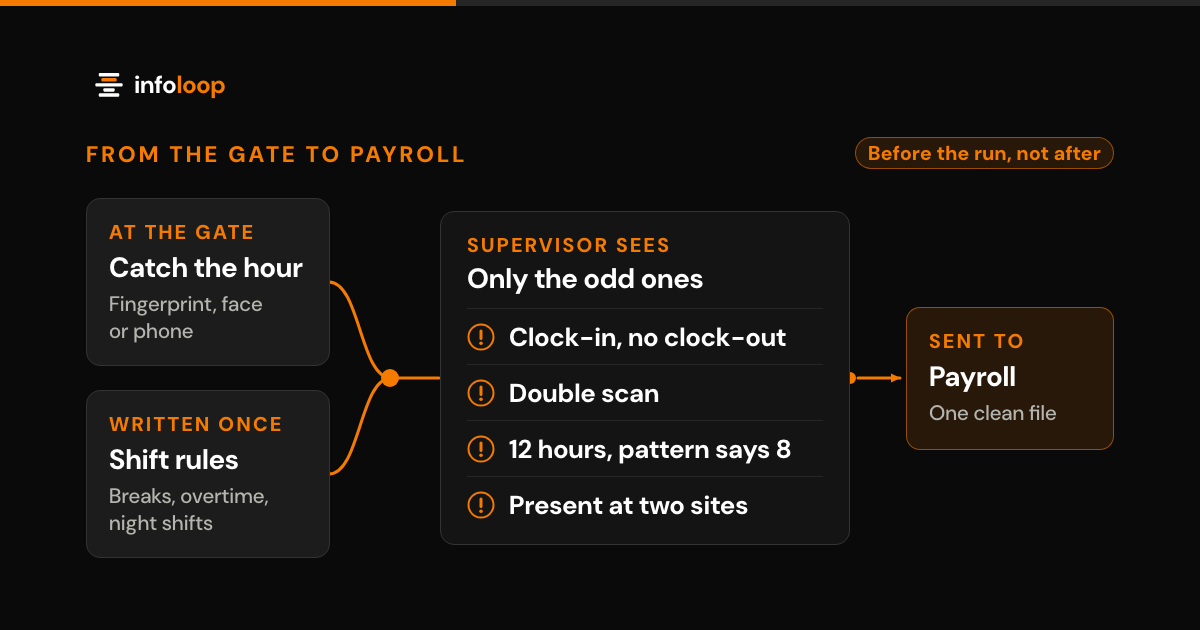
Most payroll errors begin before the payroll run, at the factory gate. Payroll attendance software closes that gap by sending approved hours directly into payroll. Our guide on how to reduce payroll errors explains where recorded hours usually go wrong.
How do you choose payroll software that complies with Indian tax laws?
Choose software that calculates all four statutory deductions, follows each state’s regulations and documents how every figure was reached. Use this checklist during the product demo:
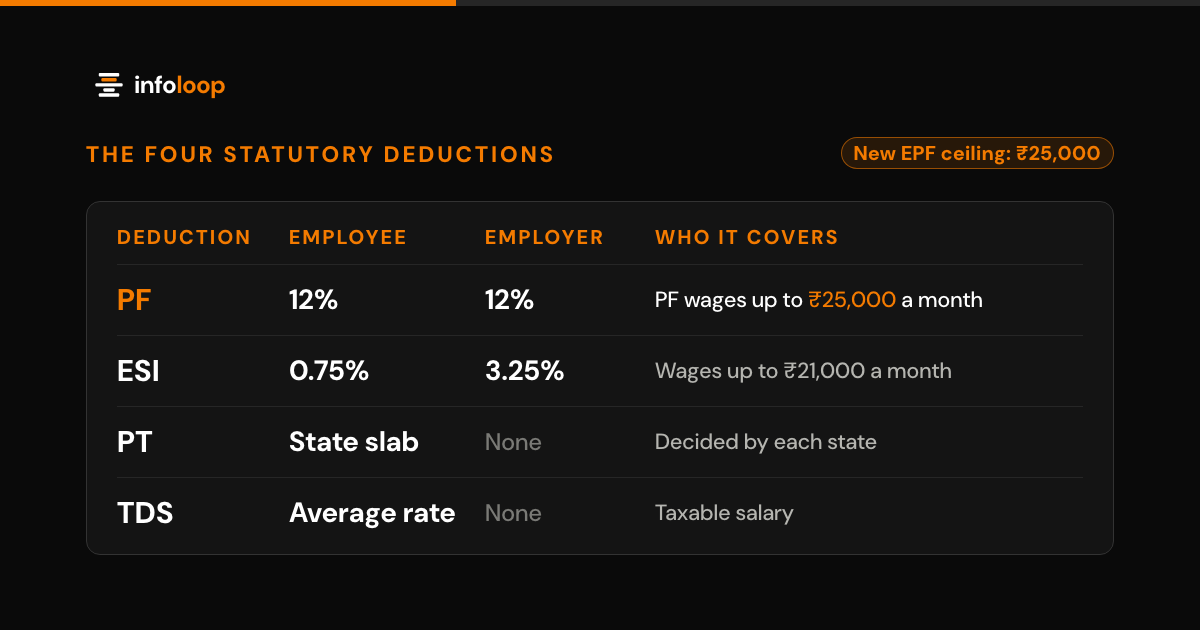
- Provident Fund: 12% from the employee and 12% from the employer, with 8.33% directed to the pension scheme. The software must apply the ₹25,000 ceiling from 17 September 2026, and move staff with PF wages between ₹15,000 and ₹25,000 into the pension scheme (EPS) from that date, if they were outside it.
- Employees’ State Insurance: 0.75% from the employee and 3.25% from the employer, for employees earning up to ₹21,000 a month.
- Professional tax: the slab table for every state where you employ people, including months with a different amount, such as February in Maharashtra.
- TDS: monthly income tax on salary under section 392 of the Income-tax Act, 2025, plus quarterly statements in Form No. 138, which replaced Form 24Q.
- Year-end certificates: Form No. 130 for every employee. It replaces Form 16, and the first one, for tax year 2026-27, is due by 15 June 2027.
- Attendance: hours, overtime and leave imported from your biometric devices, never retyped.
- Audit trail: every change recorded with the user and the time.
- Accounting: salary entries that post to Tally without duplicate typing.
- Regulation updates: a clear commitment on how quickly new rates reach your account.
One detail catches many companies. PF is calculated on wages as the Code on Social Security defines them, not on gross salary. Wages mean basic pay, dearness allowance and retaining allowance. The Ministry of Labour and Employment’s FAQs on Labour Codes add that the part of allowances above 50% of total pay counts as wages. Reliable software keeps these salary components separate and applies this 50% rule on its own, so the calculation base is always correct.
Does payroll software handle GST and PF together?
Good payroll software calculates PF together with the other statutory deductions in one run. GST never appears on a payslip, but it matters when the same system also invoices your customers.
Here are the current rates from each official source, checked in September 2026:
| Deduction | Employee pays | Employer pays | Who it covers | Source |
|---|---|---|---|---|
| PF (EPF and EPS) | 12% of PF wages | 12% (8.33% to EPS, 3.67% to EPF), plus 0.5% EDLI and 0.5% admin charges | PF wages up to ₹25,000 a month from 17 September 2026 | EPFO |
| ESI | 0.75% of wages | 3.25% of wages | Wages up to ₹21,000 a month (₹25,000 for persons with disability) | ESIC |
| Professional tax (Maharashtra) | ₹2,500 a year for men earning over ₹10,000 a month | None | Paid as ₹200 a month and ₹300 in February | Maharashtra GST Department |
| TDS on salary | Average rate on estimated yearly salary income | None | Taxable salary | Income Tax Department |
ESIC publishes the contribution rates and requires employers to pay within 15 days after the end of each month. Under the Code on Social Security, 2020, in force since 21 November 2025, ESI applies to every establishment with 10 or more employees, except seasonal factories, and to any unit with even one employee in hazardous work, according to the Ministry of Labour and Employment’s compliance handbook. Professional tax is decided by each state government. Maharashtra’s rate schedule, for example, exempts women earning up to ₹25,000 a month.
So where does GST fit? It applies to the invoices you raise and to some contractor bills, not to salaries. When attendance, payroll and sales share one record, the same hours feed salaries, product costing and the GST invoice. That removes the monthly job of reconciling figures across three separate systems.
How much does payroll software cost?
Payroll software cost depends on how many employees you pay, where they work, and which systems the software must connect to. No single price is fair for every company, so compare quotations on an identical scope.
These factors decide the cost:
- Headcount and employee categories, such as office staff, factory workers and contract labor.
- Number of states, because every state adds its own professional tax regulations.
- Attendance devices, such as fingerprint, face recognition or RFID card readers.
- Modules, from payroll alone to a complete HRMS or ERP.
- Integrations with Tally, your bank and the software you already use.
- Implementation, including the transfer of previous salary and leave records.
- Support, including how regulation changes reach your account.
We quote after a demo. Infoloop prices OpsDeck in writing once we understand your locations, your salary policies and the integrations you need. Before the demo, you can see what the OpsDeck HRMS covers.
Which payroll software is free?
Free payroll software exists, mostly as free plans or trials for small teams and as Excel templates. It can suit a small office where every employee receives a fixed salary.
The limitations appear as you grow. Free tools often exclude attendance integration, statutory returns and customer support. Someone still has to verify every figure manually, every month. A regulation change such as the new EPF ceiling becomes that person’s problem too.
Payroll automation software justifies its cost when manual verification takes more than one day each month. It also pays off when a late or incorrect PF return would attract interest and penalties.
What is the best AI for payroll?
The best AI for payroll checks your inputs before the payroll run and leaves the final calculation to fixed rules. It should never change a statutory figure automatically.
AI is useful for a few specific tasks:
- Flagging a clock-in with no clock-out, or two scans one second apart.
- Identifying overtime far above an employee’s usual pattern.
- Catching a new employee with no PF or ESI number.
- Answering employee questions about their own payslip.
Can ChatGPT do payroll? A general chatbot can explain a regulation, but it should not calculate PF or TDS for your employees. It can produce an incorrect answer that sounds convincing, and it keeps no audit trail. Payroll requires figures you can trace to a punch, a rate and a date.
How Infoloop helps
OpsDeck is Infoloop’s HRMS, CRM and ERP software for Indian manufacturers. Its HRMS and Recruitment module runs payroll from the hours recorded in attendance and works out PF, ESI, PT and TDS in the same run. OpsDeck has a native Tally integration and sends WhatsApp notifications, and the ERP module raises GST e-invoices. The HRMS typically goes live 2 to 4 weeks after sign-off.
At one manufacturer, the OpsDeck attendance module went live across three plants in three weeks. Timesheet administration fell by 90%, and no missed punches reached payroll (read the case study).
Run a manufacturing business in India? Book an OpsDeck demo and walk through your own shifts, states and salary rules with our team.
Frequently asked questions
Which payroll software is best in India?
The best payroll software in India is the one that gets PF, ESI, PT and TDS right from your own attendance data. Check that it handles your state's PT slabs, the new ₹25,000 EPF ceiling and your shift rules. Then test it on one past month of your payroll.
How much does payroll software cost?
Payroll software cost depends on your headcount, the states you pay in, the modules you need and the tools it must link to. Biometric devices, a Tally link and moving old data add to setup. Infoloop quotes OpsDeck in writing after a demo, once the scope is clear.
Which payroll software is free?
Some cloud payroll tools offer free plans or trials for small teams, and many firms start in Excel. Free options often leave out statutory returns, attendance links and support. Once you pay staff in more than one state, the hours spent checking by hand can cost more than a paid tool.
Can I use Excel for payroll?
Yes, you can run payroll in Excel for a small team, but the risk grows with every hire. Each rule change, such as the new EPF ceiling, means editing formulas by hand. Excel keeps no audit trail, and one wrong cell can flow into every payslip.
What is the best AI for payroll?
The best AI for payroll checks the inputs before the run and leaves the final sums to fixed rules. It can flag missed punches, odd overtime or a new joiner with no PF number. A person should still approve each change, because statutory figures must be exact and traceable.

Co-founder and CEO
Nimit leads Infoloop's custom software and AI work, for companies whose processes don't fit packaged software.